Updated 25 September 2026 with the 2026 licence and capital rules by regulator, the UAE CMA change and Google’s ad verification waves.
Starting a forex brokerage means building a business that connects traders to the global currency market. A brokerage provides the trading platform, license, liquidity, and support that allow clients to buy and sell currencies.
To start a forex brokerage, you need to choose your target market, acquire a license, set up a trading platform, secure liquidity, and create a client acquisition strategy.
What Is a Forex Brokerage?
A forex brokerage is a company that gives traders access to the foreign exchange market. Instead of connecting directly to banks or liquidity providers, traders open accounts with a broker who supplies the trading platform, pricing, and execution.
The difference between a broker and a trader is simple. A trader buys and sells currencies to make a profit. A broker makes those trades possible by providing the tools, licenses, and infrastructure needed to enter the market.
Why Start a Forex Brokerage?

Step-By-Step Guide On How To Start Forex Brokerage
Building a forex brokerage is not just about setting up a platform and waiting for traders. It requires careful planning, compliance with regulations, strong technology, and a clear growth strategy. Each step builds the foundation for a business that can attract clients, handle risk, and stay profitable in a competitive market.
1. Identify your target market
The first step is knowing who you want to serve. Retail clients and institutional traders have very different needs. Retail traders often look for easy-to-use platforms, education, and quick payments. Institutional clients expect deeper liquidity, advanced reporting, and compliance standards.
Demographics and culture matter too. In some regions, traders prefer mobile-first apps, while in others they value desktop tools and multilingual support. Regulations also vary by country, so aligning your offer with local laws builds trust and avoids penalties.
2. Create a forex brokerage business plan
A brokerage without a plan risks failing before launch. Your business plan should set financial projections, outline startup and ongoing costs, and define how you will earn revenue.
Typical income streams include spreads, commissions, and swaps. You may also add premium services like managed accounts or advanced charting. Think long-term: build scalability into your plan so the business can grow without constant restructuring.
3. Choose your brokerage model
The operating model defines how you handle client trades:
- A-Book: You route trades directly to liquidity providers. Transparent but requires strong connections.
- B-Book: You act as the counterparty to client trades. Profitable if managed well, but riskier.
- Hybrid: A mix of both, letting you manage risk flexibly.
The right model depends on your risk appetite, resources, and client base.
4. Select jurisdiction and obtain a license
Licensing is what makes a brokerage credible. The big regulators, such as the FCA in the UK, ASIC in Australia and CySEC in Cyprus, carry the most weight with clients and banks. They also ask for the most capital and the strictest compliance. Offshore licences in places such as Seychelles, Mauritius or Vanuatu are faster and cheaper, and they carry less trust. The table below shows what each regulator asked for in 2026.
Factor in both cost and timeline. A license can take months and requires solid compliance policies.
Licence and capital rules in 2026, by regulator
The figures below are the minimum capital each regulator asked for when we checked on 25 September 2026. They change, and most regulators add other tests. Confirm them with the regulator before you set a budget. Nothing here is legal advice.
| Regulator | Licence | Minimum capital | Rule and date |
|---|---|---|---|
| FCA, United Kingdom | Investment firm that deals on its own account | £750,000. A firm that holds client money but does not deal on its own account needs £150,000, and one that does neither needs £75,000. | MIFIDPRU 4.4, in force since 1 January 2022 |
| CySEC, Cyprus | Cyprus investment firm | €750,000 for a market maker. €150,000 for an STP firm that holds client money. €75,000 for a firm that holds no client money. | EU Investment Firms Regulation, article 9, applied since 26 June 2021 |
| ASIC, Australia | AFS licence for a retail OTC derivatives issuer | A$1,000,000 in net tangible assets | ASIC Regulatory Guide 166 |
| FSCA, South Africa | ODP licence plus a FAIS licence that covers derivatives | Set by a risk-based formula, with no flat minimum | Financial Markets Act regulations of 9 February 2018 |
| CMA, United Arab Emirates, onshore | Category 1 licence with the OTC derivatives activity | Set by the CMA in the licence conditions | Decree-Laws 32 and 33 of 2025, in force since 1 January 2026 |
| SEC, Nigeria | Online forex and CFD broker, draft rules | ₦3 billion for a dealing broker, ₦2 billion for a non-dealing broker, ₦5 billion for a platform, and 30% Nigerian ownership. Draft only, not in force. | Draft rules published 1 September 2026 |
| CMA, Kenya | Online forex broker | KES 50 million for a dealing broker, KES 30 million for a non-dealing broker, KES 10 million for a money manager | Online Foreign Exchange Trading Regulations 2017 |
| FSA, Seychelles | Securities dealer | US$100,000, up from US$50,000 | Securities amendment regulations 2024, in force since 1 January 2025 |
| FSC, Mauritius | Investment dealer, full service without underwriting | MUR 1,000,000. With underwriting, MUR 10,000,000. | FSC licensing rules for investment dealers |
Two other rules changed the cost of a launch in 2026. In the UAE the onshore licence moved from the SCA to the new CMA on 1 January 2026. A Category 5 licence only lets you promote and introduce. It does not let you take orders. And since 23 July 2026 Google asks brokers to verify with the local regulator before they can run financial ads in most of Europe, with a second wave from 15 September 2026. A brokerage that plans to buy traffic needs its licence before its ad account.
Sources: FCA Handbook MIFIDPRU 4.4. EU Regulation 2019/2033, article 9. ASIC RG 166. FSCA Financial Markets Act regulations. UAE Decree-Laws 32 and 33 of 2025. SEC Nigeria draft rules of 1 September 2026. Kenya online forex trading regulations of 2017. Seychelles securities amendment regulations of 2024. Mauritius FSC licensing criteria. Google Ads policy update on financial services verification, 23 June 2026. Checked 25 September 2026.
5. Set up a trading platform
Your platform is the face of your brokerage. Options like MetaTrader 4, MetaTrader 5, cTrader, or Quadcode are widely used.
White-label solutions let you start quickly at lower cost, while custom platforms provide more control but demand higher investment and technical resources. Choose based on your budget and growth goals.
6. Secure a back office solution
Running a brokerage requires more than just a platform. You need systems for KYC/AML checks, client management, billing, and reporting.
A strong back office keeps operations efficient and compliant. It also supports sales, affiliate management, and customer service.
7. Address liquidity needs
Liquidity ensures clients can enter and exit trades at fair prices. If you run an A-Book or Hybrid model, you must partner with reputable liquidity providers or aggregators to guarantee deep order books and competitive spreads.
If you run a B-Book model, the focus shifts to risk management — balancing trades internally and monitoring exposure carefully.
8. Integrate payment solutions
Traders expect fast and secure deposits and withdrawals. Offer multiple payment methods such as credit cards, bank transfers, and e-wallets to cover different regions.
Ensure your providers follow AML rules and offer encryption to protect funds and data. Smooth payments build trust and reduce churn.
9. Implement risk management protocols
A brokerage faces both trading and operational risks. Limit leverage, check counterparties, and hedge when needed to reduce trading risk.
On the operational side, prepare for IT failures and cyber threats with backups, audits, and strong cybersecurity. Regulatory compliance should guide every part of your risk management.
10. Develop an affiliate program
Affiliates can drive significant client acquisition. Offer competitive models such as cost-per-acquisition (CPA), revenue share, or spread share.
Work with influencers, educators, and financial communities that align with your audience. Track results transparently and reward fairly to build lasting partnerships.
11. Design a marketing strategy
A strong brand and marketing plan make the difference in a crowded industry. Use SEO to capture search traffic, paid ads to reach active traders, and social media to build community.
Position your brand clearly. Combine acquisition campaigns with retention strategies like webinars, education, and loyalty programs.
12. Initiate client acquisition
Once everything is in place, launch your brokerage to the market. Use targeted campaigns to reach your niche, then support those clients with responsive service and competitive conditions.
Balancing acquisition with retention is key. Attract new traders, but also focus on keeping them active and satisfied over the long term.
What Costs to Consider When Starting a Forex Brokerage
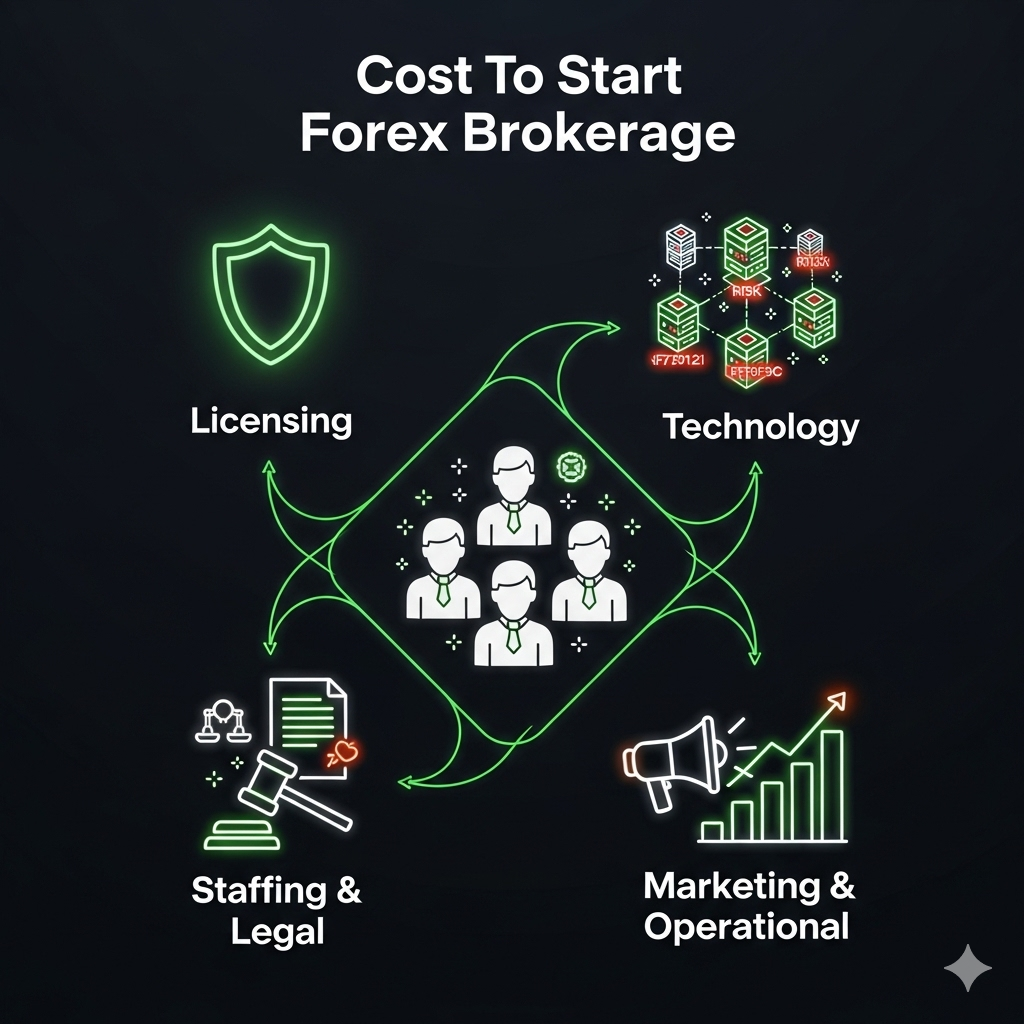
The cost of starting a forex brokerage depends on the license you choose, the technology stack, and how you plan to market the business. It is not a small investment, but breaking it down helps you see where the money goes.
Licensing fees vary widely by jurisdiction. A license from a top-tier regulator costs more but adds credibility. Offshore licenses are cheaper but may limit reputation.
Platform and technology costs include trading software, back-office systems, servers, and security. White-label platforms reduce upfront costs, while custom solutions require a larger budget.
Staffing, legal, and compliance expenses are ongoing. You need qualified staff to handle client service, IT, compliance, and operations. Legal fees also cover contracts, KYC, and AML requirements.
Marketing and operational costs continue after launch. These include advertising, affiliate programs, retention campaigns, and daily expenses like office, hosting, and payment processing fees.
Revenue Streams of a Forex Brokerage
A forex brokerage earns revenue through several channels. Understanding these income sources helps you design a sustainable business model.
Spreads and commissions are the most common. Brokers either mark up the spread between bid and ask prices or charge a direct commission per trade. The more clients trade, the more revenue you generate.
Swap fees and currency conversion fees add another layer. Swap fees apply when clients hold positions overnight, while conversion fees come from deposits and withdrawals in different currencies.
B-Book profits are possible if you run a market-making model. In this case, the broker takes the opposite side of trades. When clients lose, the brokerage earns. This method carries higher risk, so proper risk management is essential.
Premium add-on services can boost earnings. Examples include advanced charting tools, virtual private servers (VPS), educational packages, and account management services. These extras diversify income and attract serious traders willing to pay for more features.
White Label Vs. Starting From Scratch
When launching a forex brokerage, you can either build everything from the ground up or work with a white label provider. Each path comes with different costs, control, and timelines.
Starting from scratch gives you full control over technology, branding, and operations. You can design custom features and shape the business exactly how you want. The downside is the price and time. Developing your own trading platform, setting up compliance, and securing infrastructure can take many months and require a large budget.
A white label solution is faster and more affordable. You rent a ready-made platform and infrastructure from a provider, then add your own branding and client support. The technical burden is lighter, and you can go to market in weeks instead of months. The trade-off is less flexibility and reliance on the provider’s technology.
Tips To Build A Profitable Forex Brokerage
Running a profitable forex brokerage depends on building trust, managing risk, and growing at a pace your systems can handle. Clients choose brokers they can rely on, and long-term success comes from a mix of transparency, service, and smart business planning.
- Be clear about pricing, spreads, and commissions to build trust.
- Offer fast, reliable customer support across multiple channels.
- Use data to track exposure and strengthen risk management.
- Grow step by step with stable technology and compliance in place.
Conclusion
Starting a forex brokerage is a serious business decision. Success depends on clear planning, the right license, reliable technology, and strong client acquisition. By focusing on trust, service, and risk management, you can create a brokerage that not only attracts traders but also keeps them active over the long term.
All content on Brokercatalogue.com is published for informational purposes only. We provide independent research and comparison insights, not financial or legal advice. We do not handle transactions or guarantee accuracy, and any action you take based on this information is at your own risk.
FAQs On How To Start Forex Brokerage
1. How much does it cost to start a forex brokerage?
The cost depends on licensing, technology, staffing, and marketing. Offshore setups can be cheaper, while top-tier licenses and custom platforms require a much higher budget.
2. Do I need a license to open a forex brokerage?
Yes. A license is required to operate legally and build client trust. The jurisdiction you choose will define the cost, timeline, and compliance standards.
3. How long does it take to launch a forex brokerage?
With a white label solution, you can launch in a few weeks. Building from scratch can take several months or more, depending on licensing and platform development.
4. What is the best forex brokerage model?
It depends on your goals. A-Book offers transparency, B-Book can be more profitable but riskier, and Hybrid combines both. Most modern brokerages use Hybrid for flexibility.
5. Can a new forex brokerage be profitable?
Yes, if it manages costs, earns trust, and provides strong client service. Profits come from spreads, commissions, swaps, and premium services, but success requires careful planning and risk management.